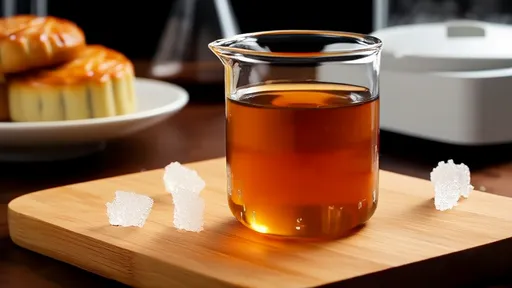
The golden sheen and tender texture of traditional mooncake syrup depend on a delicate scientific balance, where the threat of sugar crystallization – known as "sugar sanding" – looms as a constant challenge. Behind this culinary phenomenon lies an intriguing interplay between sucrose molecules and an unexpected ally: citric acid. For generations, Chinese pastry chefs have intuitively used lemon juice or sour fruits to stabilize their syrups, but modern food science now reveals the precise mechanisms at work.
At its core, sugar sanding occurs when sucrose molecules, over time, escape their dissolved state and re-crystallize into gritty particles that ruin mooncake's signature mouthfeel. This process is thermodynamically inevitable in pure sugar solutions. However, when citric acid enters the equation, it initiates a silent chemical revolution. Under heat and acidic conditions, the disaccharide sucrose undergoes hydrolysis, breaking down into its component monosaccharides: glucose and fructose. This molecular fragmentation is the first line of defense against crystallization.
The transformed sugar profile creates what chemists call a "crystallization interference system." Unlike uniform sucrose molecules that easily stack into orderly crystals, the irregular shapes and sizes of glucose and fructose molecules physically disrupt crystalline formation. Picture trying to assemble a perfect brick wall with mismatched stones – the structural imperfections prevent tight packing. Moreover, fructose's higher solubility creates a "solvent barrier," making it energetically unfavorable for any remaining sucrose molecules to crystallize.
Citric acid's role extends beyond initial hydrolysis. During the syrup's aging process – that critical period when mooncake fillings mature – the acid continues to exert influence. It chelates trace minerals like calcium and magnesium that might otherwise serve as nucleation sites for sugar crystals. This mineral sequestration is particularly crucial in commercial production where water quality varies. Artisan producers using well water or hard tap water unknowingly benefit from this aspect of citric acid's functionality.
The timing and temperature of acid addition prove equally vital to the anti-crystallization effect. Traditional recipes often add lemon juice early in the boiling process, but laboratory tests reveal that introducing citric acid at 110°C (230°F) – just before the final temperature peak – optimizes inversion while minimizing fructose degradation. This precision timing preserves the syrup's reducing sugar content at 60-70%, the ideal range for both texture and browning reactions during baking.
Modern mooncake manufacturers face an additional challenge: shelf-life extension without preservatives. Here, citric acid plays a dual role. By maintaining syrup stability, it prevents the moisture migration that often accompanies sugar crystallization – a key factor in staling. The acid's pH-lowering effect also creates an environment hostile to spoilage microorganisms, though this bacteriostatic action is secondary to its primary anti-crystallization function.
Regional variations in mooncake recipes demonstrate citric acid's adaptability. Cantonese-style syrups typically use 0.1-0.3% citric acid by weight, while Suzhou's savory-sweet versions employ slightly higher concentrations to compensate for lower cooking temperatures. The acid's impact on flavor profiles is equally fascinating – it brightens floral notes in osmanthus-infused syrups and rounds out the harshness of certain nut pastes, proving its worth beyond mere texture modification.
As clean-label trends grow, some artisans are revisiting traditional acid sources like hawthorn or tamarind, but consistency remains a challenge. Food chemists note that while these alternatives contain natural acids, their variable composition makes precise inversion control difficult. This explains why even heritage mooncake makers increasingly pair traditional ingredients with measured citric acid for reliable results.
The science of mooncake syrup continues to evolve. Recent studies explore citric acid's synergy with oligosaccharides like maltotriose, which can further enhance moisture retention. Other research investigates how different acidulants – malic, tartaric, or phosphoric acids – might offer specialized crystallization profiles for innovative textures. Yet after decades of experimentation, citric acid remains the gold standard, its multifaceted action in preventing sugar sanding unmatched by any single modern additive.
Behind every silky bite of perfectly aged mooncake lies this invisible chemical ballet – where sucrose molecules are gently persuaded to remain in chaotic dissolution rather than orderly crystals. It's a testament to how traditional culinary wisdom often anticipates scientific explanation, and how even the simplest ingredients can perform minor miracles of food chemistry.
By /Jul 31, 2025

By /Jul 31, 2025

By /Jul 31, 2025
By /Jul 31, 2025
By /Jul 31, 2025

By /Jul 31, 2025
By /Jul 31, 2025
By /Jul 31, 2025

By /Jul 31, 2025
By /Jul 31, 2025

By /Jul 31, 2025
By /Jul 31, 2025
By /Jul 31, 2025

By /Jul 31, 2025

By /Jul 31, 2025
By /Jul 31, 2025
By /Jul 31, 2025

By /Jul 31, 2025
By /Jul 31, 2025

By /Jul 31, 2025
